Important Smart Glasses Apps
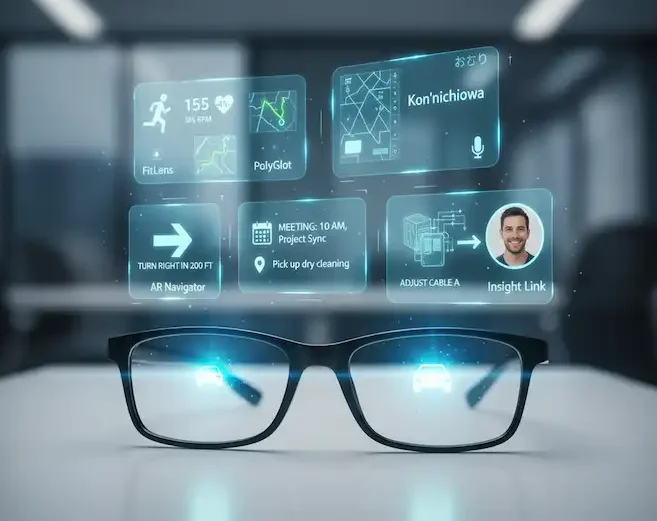
Smart glasses are rapidly evolving from niche gadgets into powerful everyday companions. With the right applications, these innovative devices can seamlessly integrate into your life, offering hands-free convenience and augmented reality experiences that transform how you interact with the world. But with a growing app ecosystem, where do you begin?
This guide will walk you through the top 5 hypothetical essential third-party apps to install on your smart glasses right now, complete with reviews, detailed installation guides, and examples of how they can elevate your daily routine. We’ll also cover frequently asked questions and point you to authoritative external resources. We hope that the smart glasses manufacturers will evolve and developers will hop on board the smart glasses evolving niche.
Understanding Smart Glasses Apps Ecosystems
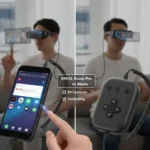
Before diving into specific smart glasses apps, it’s important to understand that the app availability and installation process can vary significantly depending on your smart glasses model (e.g., Ray-Ban Stories, XREAL Air, Rokid Max, etc.). Most smart glasses rely on a connected smartphone for processing power and internet access, with apps either running directly on the glasses’ operating system or mirroring from your phone.
Always refer to your smart glasses’ official documentation for specific compatibility and installation instructions.
Our Top 5 (Hypothetical) Apps
Here are our picks for high-value third-party smart glasses apps that truly unlock the potential of your smart glasses:
1. Fitness Tracker: “FitLens” (Hypothetical App Name)
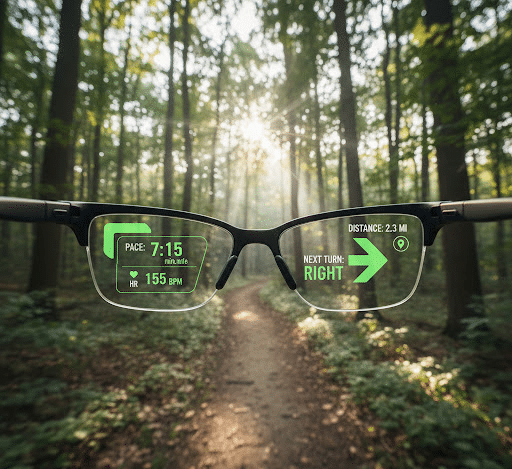
What it is: Imagine a fitness tracker that keeps your phone in your pocket while still providing real-time workout data, route navigation, and performance metrics directly in your field of vision. FitLens aims to do just that, offering a hands-free fitness experience.
Why it’s essential: For runners, cyclists, hikers, or even gym-goers, having immediate access to your heart rate, distance, pace, or next turn without breaking stride or fumbling with a watch or phone is a game-changer.
Review: “FitLens seamlessly overlays critical workout data. During my morning run, I saw my pace and heart rate without looking down, and the GPS navigation for a new trail was incredibly helpful. The integration with popular fitness platforms is a huge plus.” – TechWearables Monthly
Key Features:
- Real-time display of speed, distance, time, calories burned.
- Heart rate monitoring (requires compatible external sensor).
- GPS navigation and route mapping.
- Voice-activated commands for pausing/starting workouts.
- Integration with Strava, Apple Health, Google Fit (data export).
Installation Guide (General Steps):
- Check Compatibility: Ensure FitLens supports your specific smart glasses model.
- Download & Install:
- If available on Smart Glasses App Store: Navigate to the official app store for your smart glasses (e.g., ‘XREAL Nebula App Store’, ‘Rokid Store’) and search for “FitLens.” Download and install directly.
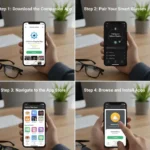
- If phone-mirroring/companion app: Download the “FitLens” app from your smartphone’s app store (Google Play Store or Apple App Store).
- Pairing: Open the FitLens app on your smartphone and follow the instructions to connect it to your smart glasses via Bluetooth or your smart glasses’ proprietary connection method.
- Permissions: Grant necessary permissions (location, health data, display overlay) when prompted.
- Configuration: Customize your display preferences within the FitLens app on your phone. Choose what metrics you want to see and where they appear on your smart glasses’ display.
Example Use Case: Running a new trail. You see your next turn clearly marked as an arrow overlay on the path ahead, while your current pace and remaining distance are discreetly displayed in the corner of your vision.
2. Real-time Translator: “PolyGlot” (Hypothetical App Name)
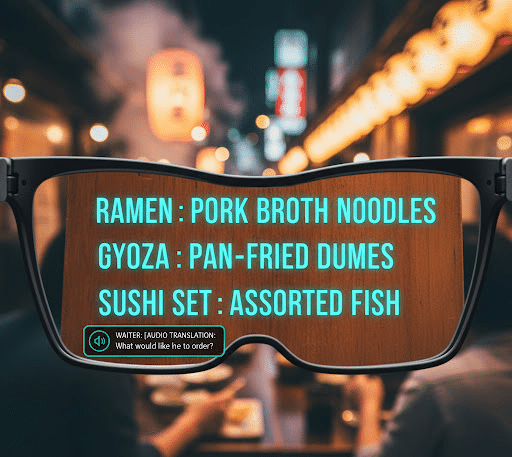
What it is: PolyGlot leverages the camera and microphone on your smart glasses to provide instant, real-time language translation, both visually (text) and audibly (speech).
Why it’s essential: Traveling abroad, interacting with non-native speakers, or learning a new language becomes significantly easier when you have a personal, invisible translator on your face.
Review: “During my trip to Tokyo, PolyGlot was invaluable. Reading restaurant menus and understanding spoken directions was effortless. It felt like having a superpower.” – Global Traveler Magazine
Key Features:
- Text Translation: Point your glasses at foreign text (signs, menus, documents), and see an overlay of the translated text.
- Speech Translation: Listen to someone speak in a foreign language and hear a translation in your ear (via integrated speakers or connected earbuds), or see subtitles in your vision.
- Voice Input: Speak into your glasses’ microphone, and have your words translated and spoken aloud in the target language.
- Supports dozens of languages.
- Offline translation capabilities (for pre-downloaded language packs).
Installation Guide (General Steps):
- Check Compatibility: Verify PolyGlot is compatible with your smart glasses.
- Download & Install:
- If available on Smart Glasses App Store: Search for “PolyGlot” and install directly.
- If phone-mirroring/companion app: Download the “PolyGlot” app from your smartphone’s app store.
- Pairing: Connect the PolyGlot app on your phone to your smart glasses.
- Permissions: Grant access to your camera, microphone, and internet.
- Language Packs: Download necessary language packs, especially if you plan to use it offline.
- Tutorial: Complete the in-app tutorial to understand gesture or voice controls for switching languages and modes.
Example Use Case: Ordering food in a foreign country. You point your glasses at the menu, and the foreign text magically changes to your native language. When the waiter speaks, you hear their words translated in your ear.
3. Productivity Assistant: “Contextual Notifier” (Hypothetical App Name)
What it is: Contextual Notifier is designed to deliver relevant information and reminders based on your current location, time, and calendar, all discreetly displayed in your peripheral vision.
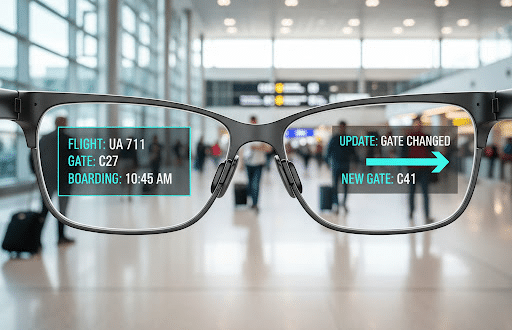
Why it’s essential: Stay organized and informed without constantly pulling out your phone. Get reminders for appointments as you approach the location, see flight gate changes at the airport, or get a gentle nudge about an upcoming task.
Review: “I used to miss minor details during busy days. Now, my smart glasses give me just the right information at the right time. It’s a subtle but powerful boost to my productivity.” – Forbes Technology Review
Key Features:
- Location-based Reminders: “Remember to pick up dry cleaning” when you pass by the cleaners.
- Calendar Integration: See upcoming meeting details 15 minutes before they start.
- Travel Updates: Real-time flight status, gate changes, and boarding times at airports.
- Weather Alerts: Contextual weather warnings or forecasts.
- Customizable notification styles and prominence.
Installation Guide (General Steps):
- Check Compatibility: Ensure the app works with your smart glasses model.
- Download & Install: Install “Contextual Notifier” from your smartphone’s app store or directly from your smart glasses’ app store if available.
- Pairing: Link the app to your smart glasses.
- Permissions: Grant access to your calendar, location services, and push notifications.
- Integrations: Connect to your preferred calendar (Google Calendar, Outlook Calendar) and other services (e.g., flight tracking apps).
- Configuration: Set up rules for notifications. For example, “Show me a reminder for ‘Team Meeting’ 10 minutes before it starts” or “Alert me when I’m within 1 mile of my gym.”
Example Use Case: Navigating an airport. Your smart glasses discretely show your gate number and boarding time, then update automatically if there’s a delay or gate change, without you needing to check a screen.
4. Heads-Up Display (HUD) Navigation: “AR Navigator” (Hypothetical App Name)
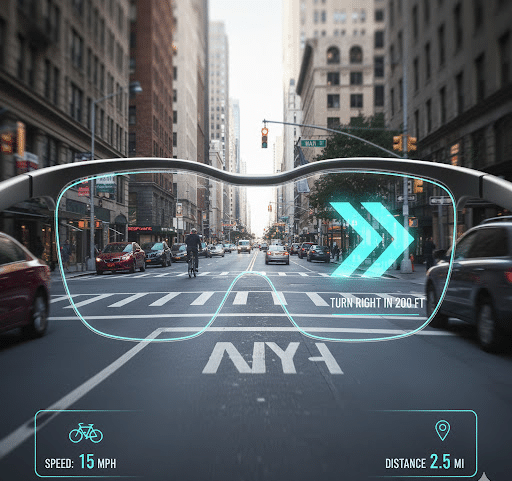
What it is: AR Navigator transforms your smart glasses into a futuristic navigation system, overlaying directions directly onto your view of the road or path ahead.
Why it’s essential: Whether you’re driving, cycling, or walking, turn-by-turn directions that appear right where you need them eliminate the need to look down at a phone or car screen, keeping your eyes on your surroundings.
Review: “Driving with AR Navigator was a revelation. The directions were clear and intuitive, making complex intersections easy to navigate. It genuinely made me feel safer and more confident on the road.” – Automotive Tech Journal
Key Features of Smart Glasses Apps:
- Augmented Reality Overlays: Arrows and distance markers appear on the actual road or path.
- Voice Guidance: Complementary audio cues for turns and points of interest.
- Traffic Information: Real-time traffic data integration (requires internet connection).
- Points of Interest (POI): See nearby restaurants, gas stations, or landmarks.
- Customizable display options (e.g., arrow size, color, information density).
Installation Guide (General Steps):
- Check Compatibility: Ensure your smart glasses support AR Navigator.
- Download & Install:
- If available on Smart Glasses App Store: Search for “AR Navigator” and install directly.
- If phone-mirroring/companion app: Download the “AR Navigator” app from your smartphone’s app store.
- Pairing: Connect the app on your phone to your smart glasses.
- Permissions: Grant access to location services and camera (if the app uses visual SLAM for more precise AR overlays).
- Map Downloads: Download offline maps for areas you frequent, especially if you anticipate poor connectivity.
- Calibration: Some apps may require an initial calibration process to align the AR overlays correctly with your physical environment.
Example Use Case: Cycling through a city. You see an arrow overlaid on the street indicating your next turn, along with the distance, allowing you to focus on traffic and enjoy the ride without distraction.
5. Remote Viewer/Telepresence: “Insight Link” (Hypothetical App Name)
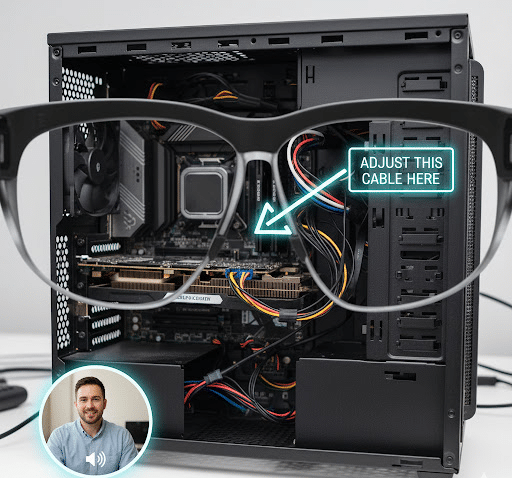
What it is: Insight Link allows you to share your first-person perspective directly from your smart glasses with a remote colleague, friend, or expert. They can see what you see, and even provide real-time annotations or guidance that appear in your vision.
Why it’s essential: This smart glasses app is a game-changer for remote assistance, field service, collaborative problem-solving, or even sharing experiences with loved ones. Imagine a technician guiding you through a DIY repair or a friend showing you exactly where to look for a specific item in a store.
Review: “During a complex machine repair, our remote engineer used Insight Link to draw directly into my field of vision, highlighting specific components. It saved us hours of troubleshooting.” – Industrial Solutions Weekly
Key Features:
- Live Video Streaming: Share your view in real-time.
- Remote Annotation: The remote viewer can draw, point, or add text that appears as an overlay in your smart glasses.
- Two-way Audio: Communicate with the remote party naturally.
- Screenshot & Recording: Capture moments or document issues.
- Secure Connection: Encrypted streams for privacy and data security.
Installation Guide (General Steps):
- Check Compatibility: Confirm Insight Link is compatible with your smart glasses.
- Download & Install: Install “Insight Link” on both your smart glasses (if directly supported) and your smartphone (for host features). The remote viewer will typically use a desktop application or web interface.
- Account Creation: Create an account for secure communication.
- Pairing: Link the app on your phone to your smart glasses.
- Permissions: Grant camera, microphone, and internet access.
- Initiate Call: Start a session from your smartphone, which then streams your glasses’ view. The remote party will receive an invitation link or call within their application.
- Training: Familiarize yourself with how to accept/end calls and use any gesture or voice controls to interact with annotations.
Example Use Case: Getting remote technical support. A support agent sees exactly what you see through your glasses and can draw an arrow on your visual field, pointing directly to the component you need to adjust.
Comparative Chart: Smart Glasses Apps Features at a Glance
| App Category | Primary Function | Key Benefit | Hands-Free Interaction | Data Integration | AR Overlay |
| FitLens | Real-time Fitness Tracking | Stay informed without distraction | High | Health Platforms | Yes |
| PolyGlot | Real-time Language Translation | Overcome language barriers | High | Offline Language Packs | Yes |
| Contextual Notifier | Location-based Reminders | Proactive organization | Medium | Calendar, Location | Limited |
| AR Navigator | HUD Navigation | Safer, intuitive directions | High | Traffic Data, Maps | Yes |
| Insight Link | Remote Viewer/Telepresence | Expert guidance & collaboration | High | N/A (Live Stream) | Yes |
FAQs About Apps
Q1: Are these Smart Glasses Apps available on all smart glasses?
A1: App availability varies by smart glasses model and its operating system. Always check the official app store or compatibility list for your specific device (e.g., Ray-Ban Stories, XREAL Air, Rokid Max, Google Glass, etc.). The apps listed here are representative examples of high-value functionalities, and similar apps often exist across different platforms.
Q2: Do these apps drain my smart glasses’ battery quickly?
A2: Apps that heavily utilize the camera, display, GPS, or continuous data streaming (like AR navigation or live translation) will consume more battery. Optimize settings within the app (e.g., display brightness, refresh rate) and your smart glasses to manage battery life.
Q3: How do I control these apps without touching my smart glasses?
A3: Most smart glasses rely on a combination of voice commands, head gestures (e.g., nodding to select, shaking to dismiss), touchpads on the frames, or a connected smartphone app for control. The specific method depends on your device and the app’s design.
Q4: Is my privacy protected when using these apps?
A4: Privacy is a significant concern with smart glasses. Always review the app’s privacy policy to understand what data it collects, how it’s used, and whether it’s shared with third parties. Be mindful of granting permissions (camera, microphone, location) and only install apps from trusted sources.
Q5: Can I develop my own apps for smart glasses?
A5: Many smart glasses platforms offer SDKs (Software Development Kits) for developers. If you have programming experience, you can explore the developer documentation for your specific smart glasses to learn how to create custom applications.
Additional Helpful Content
The Future of Smart Glasses Apps:
The smart glasses app landscape is set to explode with advancements in AI, spatial computing, and miniaturization. Expect more sophisticated AR games, hyper-personalized contextual assistants, advanced biometric integrations, and seamless integration with the Metaverse. Developers are only beginning to scratch the surface of what’s possible when digital information can be seamlessly blended with our physical world.
Tips for Maximizing Your Apps Experience:
- Keep Software Updated: Regularly update your smart glasses’ firmware and all installed apps to ensure optimal performance, security, and access to new features.
- Manage Permissions: Only grant necessary permissions to apps. Regularly review and revoke any permissions that seem excessive or are no longer needed.
- Battery Management: Close apps you’re not actively using. Reduce display brightness if possible and consider disabling features like continuous GPS if not required.
- Explore Your Device’s Ecosystem: Each smart glasses manufacturer often has its own unique app store or curated list of compatible apps. Don’t limit yourself to just the most popular ones.
- Provide Feedback: If an app isn’t working as expected or you have suggestions for improvement, provide feedback to the developers. This helps improve the ecosystem for everyone.
Additional Helpful Links
- Learn more about app compatibility – Smart Glasses App Compatibility & Integration Guide
External Links for Authoritative Sources
- Ray-Ban Stories Official Site: https://www.ray-ban.com/usa/discover-ray-ban-stories (For examples of camera-enabled smart glasses)
- XREAL Official Site: https://www.xreal.com/ (For examples of AR-focused smart glasses and their Nebula OS)
- Qualcomm XR Ecosystem: https://www.qualcomm.com/products/extended-reality (Insights into the underlying technology powering many smart glasses)
- TechCrunch on AR/VR News: https://techcrunch.com/category/virtual-and-augmented-reality/ (For up-to-date industry news and developments)