Rokid Smart Glasses Comparison
When I wore a pair of “smart” frames in public back in 2022. I felt like a background character in a low-budget sci-fi flick. People didn’t just look; they stared at the chunky hinges and the blinking lights. Fast forward to 2026, and the landscape has shifted entirely. Now, when I walk into a coffee shop wearing the latest Rokid AI Glasses, most people just think I have a penchant for slightly modern eyewear.
If you’re caught in the middle of a smart glasses comparison, specifically looking at the newcomer Rokid AI Glasses versus the heavyweight Ray-Ban Meta (including the new Gen 2 and Display editions), you aren’t just choosing a gadget. You’re choosing how you want to interact with the world.
As someone who has spent the last year swapping between these two for everything from grocery shopping to tech conferences, I’ve realized that “better” is a moving target. Here is my unfiltered take on where these devices stand today.
The Insider’s Perspective: Why the Big Guys Are Scared
Before we dive into the specs, I want to share a bit of industry “tea.” Having talked to developers at both CES and various XR summits, there is a massive philosophical divide happening.
Meta is playing the ecosystem game. They want you locked into Instagram, WhatsApp, and Threads. Their hardware is subsidized by their desire for your data. On the other hand, companies like Rokid are operating more like “pure” hardware plays. They are integrating third-party AI like ChatGPT and DeepSeek because they don’t have their own LLM (Large Language Model) to protect.
This means Rokid users often get smarter, less “gated” AI responses, while Meta users get a more polished, aesthetic experience. It’s the classic “Android vs. iPhone” battle, but this time, it’s literally sitting on your face.
1. Design and Daily Comfort: The 12-Hour Test
If a pair of glasses isn’t comfortable after four hours, it’s not a wearable; it’s an annoyance.
The Ray-Ban Meta Experience
The Ray-Ban Meta frames are, without a doubt, the gold standard for style. They look like Wayfarers because they are Wayfarers. However, they are heavy. After a full morning of meetings, I often find myself rubbing the bridge of my nose. They weigh roughly 50 to 70 grams depending on the lens type.
The Rokid AI Glasses Edge
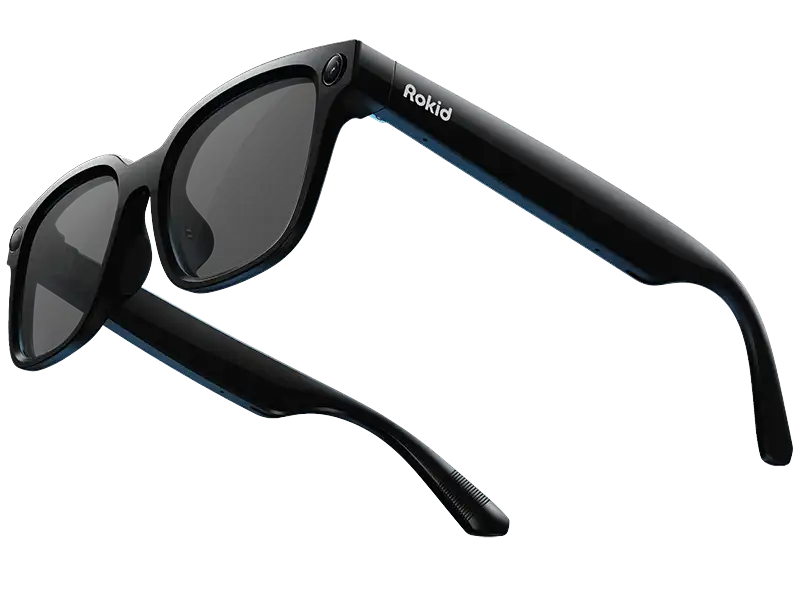
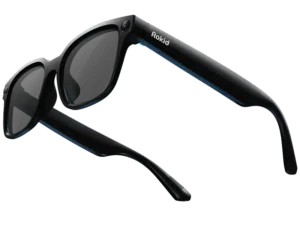
The Rokid AI Glasses (specifically the “Style” model) have been a revelation for my face. At just 38.5 grams, they are significantly lighter than the Meta counterparts. In my personal experience, those 10–20 grams make the difference between “I forgot I was wearing these” and “I need to take these off right now.”
Rokid also uses air-cushioned liquid-silicone nose pads. If you’re someone who gets “sweaty-nose-slip” (it’s a real thing!), these stay put much better than the rigid plastic of the Ray-Bans.
2. The AI “Brain” Battle
The most important part of a smart glasses comparison is how the AI actually helps you in the wild.
Meta AI: The Polished Assistant
Meta AI is snappy. You say “Hey Meta,” and it responds instantly. It’s great at identifying landmarks or telling you what kind of plant you’re looking at. But—and this is a big but—it feels limited. It often refuses to answer complex questions or refers you back to your phone. It’s a “lite” assistant designed for social convenience.
Rokid’s Multi-Engine Approach
Rokid did something brilliant: they don’t force you into one AI. Their system can toggle between ChatGPT, Gemini, DeepSeek, and Qwen.
- The Anecdote: I was in a meeting last month where I needed a quick summary of a complex tax law. Meta AI gave me a generic “I can’t help with legal advice” line. I asked my Rokid frames (connected to ChatGPT-4o), and it whispered a concise three-point summary into my ear.
For someone who values productivity over “social vibes,” Rokid wins the AI brain battle hands down.
3. The Display: Seeing vs. Hearing
This is where the smart glasses comparison gets technical.
- Ray-Ban Meta (Standard): No display. It’s all audio and camera.
- Ray-Ban Meta (Display Edition): Features a 5,000-nit monocular (one-eye) color display. It’s beautiful for checking a quick text, but it can feel a bit lopsided.
- Rokid AI Glasses: These use a dual-eye monochrome green display.
At first, I hated the green. I wanted full color. But after using them for live translation during a trip to Tokyo, I changed my mind. Because the text is in both eyes, you don’t get that “one-eye fatigue” or nausea that some people report with the Meta Display. It feels like subtitles for real life.
4. Real-World Use Cases: iPhone and Android
I’ve tested both of these on my iPhone 15 Pro and a Google Pixel.
For the Content Creator (Ray-Ban Meta)
If you live on Instagram, the Ray-Ban Meta frames are a no-brainer. The 12MP camera is optimized for vertical 9:16 video. The integration is seamless. You can livestream directly to your followers.
- Insider Tip: The “Be My Eyes” integration on Meta is a game-changer for accessibility. It lets sighted volunteers see through your camera to help you navigate—a beautiful use of the tech.
For the Professional & Traveler (Rokid)
The Rokid glasses are my “work” frames.
- Teleprompter Mode: I used these during a keynote speech. I had my notes scrolling in my field of vision. No one knew I wasn’t memorizing the whole thing.
- Meeting Transcription: They can record a meeting and give you a summary with speaker ID.
- The Charging Hack: Rokid uses a magnetic pogo-pin charger. While some find it “clunky,” it allows for a much slimmer temple design compared to the bulky “folding-arm” charger of the Ray-Bans.
5. Battery Life and Endurance
We have to be honest in this smart glasses comparison: battery life still isn’t where we want it to be.
| Feature | Ray-Ban Meta | Rokid AI Glasses |
| Standalone Use | ~4–6 hours | ~8–12 hours |
| Charging Case | Included (up to 32h) | Accessory-based (long life) |
| Charging Speed | Fast (in case) | Moderate (pogo-pin) |
I’ve found that the Ray-Bans die much faster if you’re taking a lot of video. The Rokid frames seem better optimized for “passive AI,” meaning they stay awake longer just waiting for your voice commands without draining the tank.
6. Privacy and the “Creeper” Factor
The industry is still struggling with the social stigma of cameras on faces. Both brands have a physical LED that lights up when you record.
However, the Ray-Bans are so recognizable now that people know what they are. This is a double-edged sword. It’s socially “acceptable” because it’s a brand name, but people also know they might be being filmed. The Rokid frames are more “under the radar,” which I personally prefer when I’m just trying to get AI help in a grocery store without looking like a tech influencer.
7. Price and Value: The Bottom Line
Pricing for a smart glasses comparison depends on where you buy, but as of early 2026:
- Ray-Ban Meta: Starts around $299 for standard, $799 for the Display version.
- Rokid AI Glasses: Generally range from $299 to $499 depending on the bundle.
If you want the “cool factor” and a world-class camera, pay the Meta premium. If you want a tool that actually helps you work, translate, and stay comfortable all day, the Rokid is the smarter investment.
My Final Verdict
After months of testing, my Ray-Bans mostly sit on my desk unless I’m going to a concert or a party where I want to capture POV video. For my actual life—traveling, working, and staying organized—I reach for the Rokid AI Glasses. They feel like a tool, whereas the Ray-Bans feel like a toy.
The weight difference alone is enough to tilt the scale for me. Carrying 38 grams on your face feels like the future; carrying 70 grams feels like the past.
FAQ: Common Questions About This Smart Glasses Comparison
Q: Do these glasses work with prescription lenses? Yes, both do. Rokid offers a very cool magnetic prescription insert system that handles up to -16.00D, which is massive. Ray-Ban Meta requires you to order the lenses built-in or through a certified optician, and they generally only go up to +/- 4.00D.
Q: Can I use Rokid AI Glasses with an iPhone? Absolutely. Both the Rokid AI Glasses and Ray-Ban Meta have excellent apps for both iPhone and Android. Rokid’s app is a bit more “utility” focused, while Meta View is very “social” focused.
Q: Is there a subscription fee? This is a “gotcha” in the smart glasses comparison. Meta AI is currently free. Rokid offers a “Golden” tier for some of their more advanced AI translation features (around $9.90/month), though basic ChatGPT functions usually work for free.
Q: Are they waterproof? Most are IPX4 or IPX5 rated. This means they can handle a light drizzle or sweat, but please, do not take them into the pool. I’ve seen too many “dead” smart glasses from people trying to film underwater!
Q: Which one has better speakers? Meta wins on audio. Their five-mic array and directional speakers have more bass and clarity. Rokid is “good enough” for podcasts and AI voices, but I wouldn’t use them as my primary music headphones.
Additional Helpful Information
- Read about the Ray-Ban Meta compared to XReal Air 2 Pro – Ray-Ban Meta vs Xreal Air 2 Pro
- How to setup Rokid glasses – A Guide to Rokid Glasses Setup